Dr. Ron Kikinis is the B. Leonard Holman Professor of Radiology at Harvard Medical School. He is also the Founding Director of the Surgical Planning Laboratory (SPL) at Brigham and Women's Hospital. His career is devoted to translational research, with a focus on bridging the gap between biomedical science and clinical practice. At the core of his research is the transformation of raw data from diagnostic imaging into actionable, real-time clinical insights.
Dr. Kikinis' scholarly work is extensive, and his research impact is very high. He is the author or co-author of over 424 peer-reviewed publications. His mean Relative Citation Ratio (RCR) is 3.26, meaning his papers are cited approximately three times more frequently than the NIH median, and holds an H-index of 152 (Google Scholar, 10/2025). This collaborative output reflects his commitment to both algorithmic development and making those algorithms clinically usable.
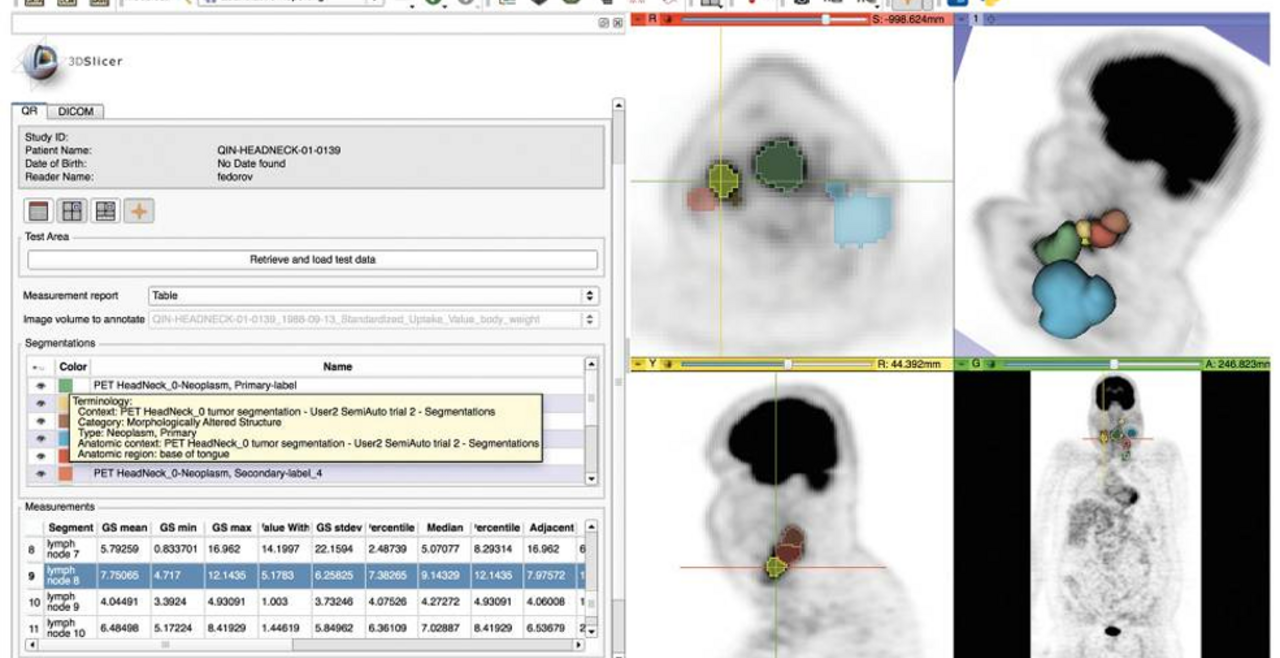
This drive for clinical translation resulted in a central achievement: the development of 3D Slicer, an open-source software platform for medical imaging computing. What began as D. Gering's master's thesis is now an international, community-supported effort led by Dr. Kikinis as Principal Investigator.
This evolution was only possible due to his skills in managing large multi-site collaborations, an expertise that was honed through participation in initiatives such as the NSF-funded Computer Integrated Surgical Systems and Technology (CISST) and the NIH-funded Biomedical Informatics Research Network (BIRN). This leadership enabled the success of major NIH-funded national centers, including the decade-long National Alliance for Medical Image Computing (NA-MIC) U54 project, and the Neuroimaging Analysis Center (NAC) P41, which concluded after 25 years of operation. He also led the dissemination and outreach components of the National Center for Advanced Technologies for Image Guided Therapy (AT-NCIGT) P41 until 2024.
Dr. Kikinis’ current NIH-funded efforts focus on informatics and oncology. He co-leads the Integrative Cancer Imaging Data Commons (IDC) with Dr. Andriy Fedorov, and is a multi-PI on an R01 grant focused on Lymph Node Quantification (LNQ), with Dr. Gordon Harris.
From 2014 to 2020, Dr. Kikinis served as Institute Director of Fraunhofer MEVIS, Bremen, Germany, where he led a comprehensive and challenging reorganization of the institute's team of approximately 100 employees and scientists.
His commitment to training future leaders is significant. His mentorship program has produced a global network of academics. This network includes over 23 former mentees who have achieved the rank of Full Professor, Endowed Chair, or Director, and 6 currently serving as Associate Professors at prestigious institutions worldwide.
Dr. Kikinis has received several prestigious honors. These include the Harvard Medical School Clifford Barger Excellence in Mentoring Award in 2019, the inaugural MICCAI Enduring Impact Award in 2009, and the JAMIT Award for Outstanding Research Achievement in 2023. He was elected Fellow of the MICCAI Society in 2009, and a Fellow of the International Society for Magnetic Resonance in Medicine (ISMRM) in 2019.
Dr. Kikinis’ personal drive underlies each, and all, of these accomplishments. His motivation is the belief that the essential outcomes of cutting-edge research at leading institutions should be made available and utilized for tangible clinical utility and broad societal benefit.
Full Length Curriculum Vitae, 10-2025.